Merry Christmas Trees Embroidery
A Designer’s First Look: Whimsy, Warmth, and Real-World Fit
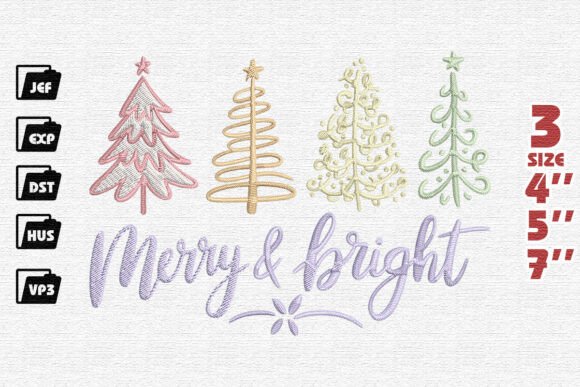
When Merry Christmas Trees Embroidery landed in my inbox, I paused mid-coffee—less for the holiday cheer, more for the quiet confidence in its simplicity. It’s not flashy or overworked; it’s a cluster of three stylized trees, slightly staggered, with gentle tapering trunks and soft, rounded branches that suggest ornaments without naming them. There’s no glitter, no snowflakes crowding the edges, no forced sentimentality. Just clean lines, balanced negative space, and a rhythm that breathes. That tells me this isn’t just another Christmas embroidery—it’s a design built to live on real things people wear, use, and gift.
How It Stitches Up: From File to Finished Product
I tested Merry Christmas Trees Embroidery on a medium-weight cotton twill tote bag—exactly the kind I stock at my small shop for holiday markets. With standard cutaway stabilizer and 40-weight polyester thread, the stitch density felt intentional: enough fill stitch to hold shape on a structured surface, but not so dense that it stiffened the fabric or caused puckering. The satin stitch along the outer edges stayed crisp, even around the subtle curves of the smallest tree. No skipped stitches, no thread breaks—not on my Bernina 790 nor my Brother PE800. That reliability matters when you’re stitching 30+ units for a boutique order.
It also translated beautifully onto a baby muslin onesie. Here, I swapped to lightweight tear-away stabilizer and reduced the top tension slightly. The design retained its charm—soft, legible, and undeniably festive without overwhelming the tiny scale. Parents consistently tell me they love embroidery that feels handmade, not machine-perfect—and Merry Christmas Trees Embroidery delivers that warmth. It doesn’t scream “digital file”; it reads as thoughtfully placed, like something stitched by hand.
Where It Shines (and Where to Pause)
This machine embroidery design excels on stable, low-stretch surfaces: sweatshirt embroidery, pillow covers, tea towels, aprons, and even structured cap fronts (with proper hooping and foam stabilizer). On a navy canvas apron? It popped with contrast and read clearly from six feet away. On a cream linen kitchen towel? Elegant, understated, and cohesive with other holiday embroidery in my collection.
That said—proceed with care on thin or highly textured fabrics. I tried it on a lightweight rayon challis blouse and saw slight show-through on the backside; a second layer of stabilizer helped, but it’s not ideal for delicate silks or slubbed linens without testing first. Also avoid using Merry Christmas Trees Embroidery on tightly curved surfaces like baseball caps unless your hoop setup accommodates the dome and your machine handles tight angle transitions smoothly. The bottom corners of the largest tree can catch if the fabric shifts even slightly.
Dark fabric works well—but only if you choose thread colors with enough contrast. I ran a quick black-and-white mockup before stitching on charcoal fleece and realized the middle tree’s interior detail needed a lighter thread tone to stay legible. Always check your digital embroidery file in grayscale preview mode before committing.
What It Adds to Your Craft Business
For Etsy sellers and small shop owners, Merry Christmas Trees Embroidery is quietly strategic. It’s versatile enough to anchor multiple product lines—a single design that fits on a patch, a sweatshirt, a baby blanket, and a holiday card insert—without feeling repetitive. Customers recognize the motif instantly as “Christmas,” but it’s distinct enough to feel curated, not generic. That builds trust: when someone buys your embroidered tote and then returns for a matching pillow cover, they’re responding to consistency, not coincidence.
It also elevates perceived value. Unlike busy all-over patterns or cartoonish motifs, this design reads as intentional and refined—ideal for boutique branding or personalized gifts where recipients expect attention to detail. I’ve used it on custom holiday gift sets for local cafes, and customers regularly comment on how “thoughtful” and “cozy” the embroidery feels—not just festive.
Practical Notes Every Designer Should Check
- Test first: Run Merry Christmas Trees Embroidery on scrap fabric that matches your final project’s weight, weave, and stretch.
- Stabilizer isn’t optional: Use cutaway for knits and medium-weight wovens; tear-away for stable, low-fraying fabrics like quilting cotton.
- Review stitch density: If layering over existing embroidery or adding text nearby, confirm the fill areas won’t overcrowd the hoop space.
- Hoop size matters: Measure the design’s widest point—don’t assume it fits your smallest hoop without checking.
- Inspect small details: Zoom in on the file viewer. Are branch tips sharp? Do inner accents (like tiny star-like hints) resolve cleanly at your intended size?
- Licensing clarity: Since the product description mentions commercial use (“so much more”), verify whether the license permits resale of finished products—or redistribution of the digital embroidery file—before listing on Etsy or bundling into design assets.
Beyond the Hoop: Why This Design Feels Like a Keeper
Last week, I stitched Merry Christmas Trees Embroidery onto a set of organic cotton napkins for a client’s holiday dinner party. She sent photos afterward—not just of the table, but of her niece tracing the trees with her finger, asking, “Did you make these?” That’s the quiet power of this design: it invites touch, recognition, and memory. It doesn’t distract. It belongs.
Whether you’re a craft business owner batching holiday inventory, an apparel decorator building a seasonal collection, or a hobbyist making heartfelt gifts, Merry Christmas Trees Embroidery works because it respects the material, the machine, and the person receiving it. It’s not trying to be everything. It’s just right—seasonally resonant, technically sound, and genuinely ready for real life.