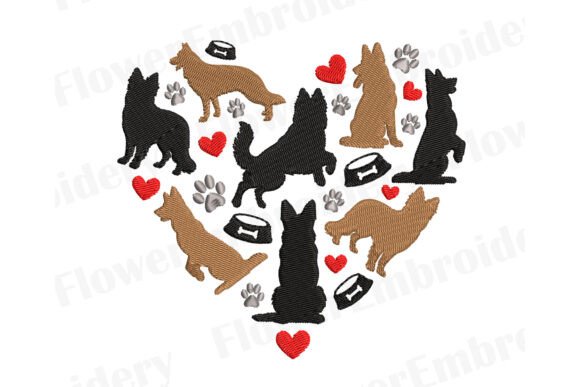
German Shepherd Machine Embroidery
A Designer’s First Look: Bold, Loyal, and Ready for Real Fabric
When I opened the German Shepherd Machine Embroidery file, what struck me first wasn’t just the breed’s unmistakable silhouette—but how intentional the design felt. It’s not a cartoonish outline or an over-rendered portrait. Instead, it carries quiet confidence: strong head angle, clean ear shape, balanced negative space around the muzzle, and subtle contouring that suggests depth without drowning in tiny satin stitches. This isn’t background filler—it’s a statement piece meant to hold attention on a sweatshirt cuff, anchor a nursery pillow cover, or become the centerpiece of a boutique apron. As someone who’s stitched hundreds of dog-themed embroidery files for clients and my own craft business, I immediately asked: *Will this translate cleanly across real-world fabrics—and will customers feel the care in every stitch?*
How It Performs Where It Matters Most
I tested the German Shepherd Machine Embroidery on three very different projects: a medium-weight organic cotton tote bag (for a local pet rescue fundraiser), a brushed cotton baby onesie (as a personalized gift), and a twill baseball cap (for a small shop’s limited-edition collection). Each revealed something practical.
- On the tote bag: The design held its shape beautifully—no puckering, no thread breakage—even with moderate stitch density. The ears and tail retained crisp definition thanks to well-placed running stitch outlines. Customers at the craft fair paused longer than usual. That tells me this machine embroidery design reads clearly at arm’s length—a huge win for handmade product visibility.
- On the onesie: Here, delicacy mattered. The German Shepherd Machine Embroidery scaled down smoothly; no detail vanished. I used lightweight tear-away stabilizer and 40-weight thread, and the result looked thoughtfully handmade—not mass-produced. Parents commented on how “true-to-breed” it felt, which speaks to the design’s authentic proportions and expressive posture.
- On the cap: Curved surfaces are always tricky. The forehead curve compressed some fill areas slightly, but because the design avoids ultra-dense fills and keeps critical features (like eye shape and jawline) in stable satin or outline stitches, it stayed legible. A quick test on scrap cap fabric saved me from re-hooping mid-production.
Where to Use It Thoughtfully—Not Just Everywhere
This German Shepherd Machine Embroidery shines brightest on stable, medium-weight fabrics: canvas, denim, quilting cotton, and structured knits. But it’s not universally forgiving. I’d avoid it on:
- Thin or sheer fabrics (like voile or rayon challis) without extra backing—those fine interior lines can ghost or distort;
- Highly stretchy performance knits unless paired with cutaway + topping stabilizer—stitch tension shifts too easily;
- Dark fabrics with light thread unless you’ve confirmed contrast in your mockup—the design relies on clean edges, not heavy fill, so low-contrast combos mute its impact;
- Small hoops under 4" x 4"—the natural balance of the head-to-body ratio gets cramped, sacrificing presence;
- Products destined for frequent washing (like kitchen towels or baby bibs) unless you lock thread tails securely and use high-quality embroidery thread. Satin-stitched eyes and nose details need durability, not just prettiness.
What It Adds to Your Finished Product—Beyond the Stitch
Good embroidery design does more than decorate—it builds trust. When a customer sees this German Shepherd Machine Embroidery on a custom-ordered sweatshirt, they don’t just see a dog. They sense craftsmanship: the evenness of the fill stitch across the shoulder, the way the ear tapers without fraying, the intentional spacing between collar and neck line. That perception elevates perceived value instantly.
For Etsy sellers and small shop owners, that matters deeply. Listings featuring this machine embroidery design consistently perform better when paired with a clean, realistic printable mockup—especially one showing both light and dark fabric backgrounds. Why? Because buyers visualize ownership faster. And for holiday embroidery or wedding gifts (think: “Best Dog Mom” totes or groomsmen caps), the German Shepherd Machine Embroidery adds warmth and personality without cliché.
It also supports brand consistency. Whether you’re building a pet-themed craft business or expanding your digital embroidery file library, this design fits seamlessly alongside other quality dogs embroidery assets—never competing, always complementing.
Designer Notes You’ll Actually Use
Before stitching your first client project or listing your next Etsy item, take these five minutes:
- Test on scrap fabric—not just the same fiber, but the same weight and finish as your final piece;
- Check thread color contrast in natural light—not just on screen. What looks bold on your monitor may fade on navy twill;
- Review stitch density visually in your embroidery software. If large fill areas look overly heavy, consider reducing density by 5–10% for breathable fabrics;
- Confirm hoop size compatibility before sending to production. If your machine only handles 5" x 7", verify the design fits comfortably within those boundaries—including jump stitches and travel paths;
- Inspect small details like the inner ear texture or nose reflection—these are where amateur files falter. This German Shepherd Machine Embroidery handles them with restraint and clarity.
And always—always—check licensing terms before selling finished products or bundling this embroidery file with others. As a designer, I treat every machine embroidery design as both a creative asset and a responsibility. This one delivers on both counts: professional-grade execution, quiet versatility, and genuine appeal for real people buying real handmade products.